Introducing Webhooks: Real-Time Link Events
We’re introducing Webhooks, a feature that lets T.LY send real-time link activity directly to your systems. If you want the support-center reference version with requirements, headers, retries, and payload examples, see the Webhooks help article.
No polling. No delays. Just real-time events delivered exactly where you want them.
What Are Webhooks?
A webhook is a mechanism for one app to automatically send data to another app when an event occurs.
Instead of asking, “Did anything change?” over and over, webhooks flip the model to “Tell me when it happens.”
A simple example
- Someone clicks or engages with a T.LY short link
- T.LY immediately sends an HTTP request to your server
- Your system receives the event and reacts in real time
That reaction could be:
- Updating a CRM
- Triggering a Slack message
- Logging engagement data
- Automation tools
Link Visit Events
The first webhook events we’re rolling out are ShortLink Visited, OneLink Visited, and OneLink Link Visited. These events fire whenever a ShortLink or OneLink receives engagement, giving you instant insight into how your links are performing.
Common Use Cases
- Track campaign performance in real time
- Trigger follow-ups when a link is clicked
- Sync link activity to internal dashboards
- Feed engagement data into attribution systems
Instead of waiting for reports, your data flows as soon as a link is used.
Precision with Tag Targeting
Not every link needs to trigger a webhook. With tag targeting, you can control exactly which links send events.
How it works
- Assign tags to your short links (for example:
email,paid-ads,onboarding) - Configure a webhook to listen only for specific tags
- T.LY delivers events only when those tagged links are engaged
Why should you add Tags
- Keep webhook traffic clean and relevant
- Separate campaigns, teams, or products
- Avoid unnecessary noise in your systems
This is especially powerful for teams running multiple campaigns or managing links at scale.
If you are new to organizing links with tags, the Tags help article explains how to keep webhook targeting clean.
How to Configure a Webhook in T.LY
Setting up a webhook takes just a minute and is designed to be straightforward for both technical and non-technical users.
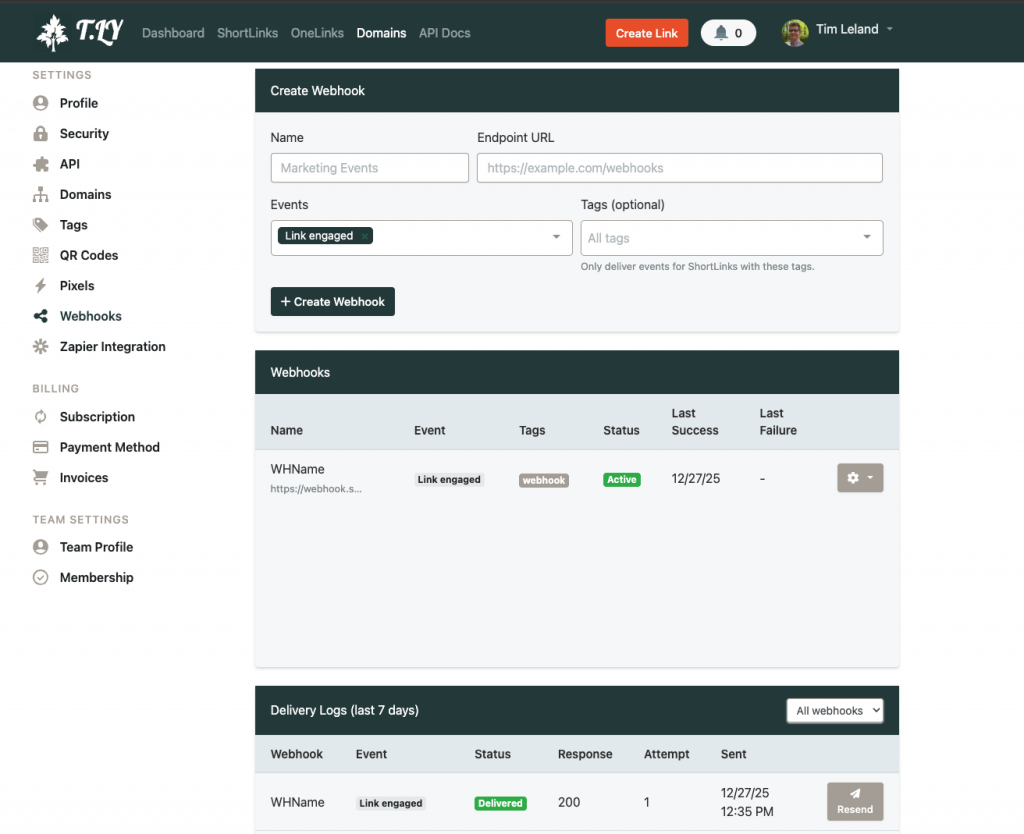
When creating a webhook, you’ll configure:
- Name: A friendly label so you know what the webhook is for
- Endpoint URL: The destination where events are sent
- Events: Select which events should trigger deliveries, such as Short Link visited
- Tags (optional): Deliver events only for links with selected tags
- Active status: Enable or disable the webhook at any time
Once active, events start flowing immediately.
Built-In Security You Can Trust
Security matters when data flows automatically between systems. Every webhook request from T.LY includes a security header: X-Tly-Key
This allows your server to:
- Verify the request came from T.LY
- Prevent spoofed or malicious requests
- Safely trust incoming webhook data
We strongly recommend validating this header on your endpoint before processing events.
Delivery Logs & Resend Support
Webhooks shouldn’t feel like a black box. Inside T.LY, you get delivery logs that show:
- When events were sent
- Whether the delivery succeeded or failed
- Response codes from your endpoint
If an endpoint was temporarily unavailable, you can resend events with a click. No data loss, no guesswork. This makes setup and debugging a lot easier.
Frequently Asked Questions
What plans are Webhooks available on?
Webhooks are available on T.LY Business plans
Do I need to be a developer to use webhooks?
No, a developer is not required to set up webhooks. Many marketers use webhooks with tools such as Zapier, custom endpoints, or internal systems built by their team.
Can I have multiple webhooks?
Yes. You can create multiple webhooks for different events, tags, or destinations.
What happens if my endpoint is down?
The delivery will be logged as failed, and you can resend the event once your endpoint is back online.
Are webhooks real-time?
Yes. Events are sent immediately upon occurrence.
Start Using Webhooks Today
Webhooks turn T.LY from a simple link shortener into a tool that can feed real-time events into the rest of your stack.
Get started now: Go to Settings → Webhooks in your T.LY settings page and create your first webhook in minutes.
If you’re already tagging your links, you’re just a few clicks away from powerful automation.
Related Posts




Tim Leland
Useful Tools
Ready to improve how you manage links?
T.LY URL Shortener makes long links look cleaner and easier to share! Add your own Custom Domains to personalize your brand. Create Smart Links to customize a URL's destination. Generate QR codes to promote your business.
Start your 5-day trial Browser Extension